Chapter 13 — The Christmas Photograph Twelve Years Later
Twelve years later, Ivy stood on the Ashbourne staircase wearing a green Christmas dress.
She was twelve.
Vivienne was ninety-one.
The family still took the annual photograph.
The tradition had changed.
Not disappeared.
Spouses stood in it.
Adopted children stood in it.
Stepchildren stood in it.
One year, a cousin’s exchange student was included because she had nowhere else to spend Christmas.
Vivienne initially objected.
Then laughed at herself.
“Apparently the bloodline survived.”
Ivy knew the story of her first Christmas at Ashbourne House.
Not every cruel detail.
Rosalie waited until she was old enough to understand context.
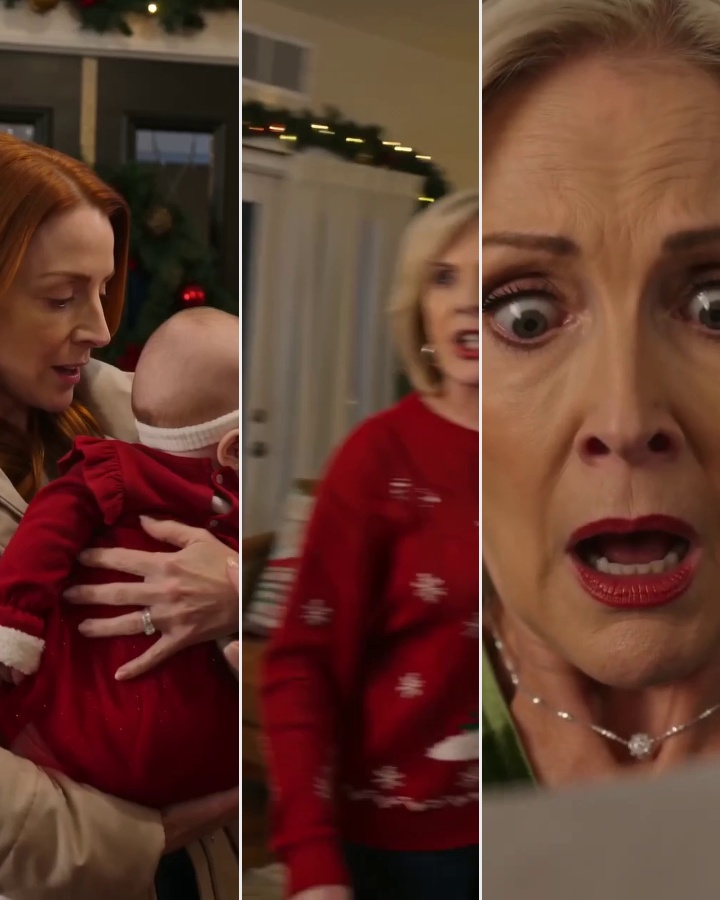
One afternoon, Ivy saw the old photograph.
Baby Ivy asleep in Rosalie’s arms.
Adrian beside them.
Vivienne standing several places away.
Ivy asked:
“Was that the Christmas Great-Grandma didn’t want me in the picture?”
Rosalie hesitated.
“Yes.”
Ivy looked toward Vivienne, who was reading across the room.
“Why?”
Rosalie answered honestly.
“She had a very narrow idea of what family was.”
“Did you show her the house papers?”
Rosalie laughed.
“Unfortunately, yes.”
“That sounds cool.”
“It felt cool for about thirty seconds.”
Ivy frowned.
Rosalie explained.
“Then I realized owning the house wasn’t why I was right.”
Ivy looked confused.
“What do you mean?”
Rosalie sat beside her.
“Imagine Great-Grandma had still owned the house.”
“Would that make you less my daughter?”
“No.”
“Would it make excluding you from the family photograph kind?”
“No.”
“Exactly.”
Rosalie had come to dislike the way relatives retold the story.
Some said:
Vivienne insulted the baby and then discovered Rosalie owned the mansion.
That made a satisfying family legend.
It was also the wrong lesson.
Because it implied Vivienne’s humiliation came from choosing the wrong person to disrespect.
As though the behavior would have been acceptable if Rosalie were financially dependent.
As though dignity came with a deed.
It did not.
The ownership papers resolved one question:
Who legally controlled decisions about Ashbourne House?
Rosalie.
But another question mattered more:
Who had the right to decide whether Ivy was Rosalie’s daughter?
That answer had never belonged to Vivienne.
Ivy’s adoption was legally final.
Rosalie’s motherhood was not a family vote.
And even before any court stamped any paper, Ivy had deserved kindness.
Vivienne eventually understood that.
The process was not magical.
She made mistakes afterward.
Once she introduced Ivy as:
“Rosalie’s adopted daughter.”
Rosalie later asked why the qualifier was relevant.
Vivienne thought about it.
Then stopped using it unless the context actually involved adoption.
Another time she referred to a cousin’s biological child as:
“our first real great-great-grandchild.”
She caught herself halfway through.
Apologized immediately.
Growth did not mean never making another mistake.
It meant recognizing one without demanding that everyone else pretend it did not happen.
Vivienne and Ivy eventually became remarkably close.
Not because the Christmas confrontation forced affection.
Because years of ordinary time did.
Books.
Tea.
Gardening.
Ivy learning to play cards badly.
Vivienne teaching her the history of every portrait hanging in the hallway.
One afternoon Ivy pointed toward an ancestor painted in 1892.
“Did she own this house?”
Vivienne nodded.
“For a while.”
“Where did it go after her?”
“To her son.”
“Then?”
Vivienne laughed.
“Many people.”
Ivy grinned.
“So nobody owns it forever.”
Vivienne looked at her.
That simple sentence struck her.
“No.”
“Nobody does.”
That Christmas, the family gathered for another photograph.
The photographer began arranging everyone.
Ivy stood beside Vivienne.
Then a younger cousin arrived carrying a foster child who was spending the holiday with them.
The cousin hesitated.
“Should he be in the formal one?”
Before Rosalie could answer, Vivienne spoke.
“Of course.”
Everyone looked toward her.
Vivienne rolled her eyes.
“Don’t all stare at me like I’ve discovered electricity.”
People laughed.
The little boy joined the photograph.
Vivienne moved slightly to make room.
Rosalie noticed.
She remembered another Christmas.
Walking into the same house with baby Ivy against her chest.
Vivienne’s smile disappearing.
The cold questions.
Then the sentence:
“Leave the baby out of the formal picture.”
Rosalie remembered wanting to leave.
Then the folder on the table.
The recorded property documents.
Vivienne insisting:
“This is my house.”
And Rosalie finally answering:
“Read who actually owns it.”
That reveal changed the balance of authority inside Ashbourne House.
But the years afterward changed something more important.
The family stopped treating tradition as a locked room where new people had to prove they belonged before someone opened the door.
Tradition became something living people were allowed to expand.
And when the photographer finally raised his camera twelve years later, Vivienne reached for Ivy’s hand.
No one asked whether the girl belonged in the picture.
No paperwork was necessary.
The answer had become ordinary.
Exactly as Rosalie had always wanted it to be.
THE END
“`