Chapter 13 — The Question Gideon Asked Years Later
Eight years later, Elsie was sixteen.
Gideon was slower now.
His cane was no longer mostly decorative.
But he still attended her birthdays.
Every one.
Sometimes quietly.
Sometimes with embarrassing gifts.
Everett and Gideon never became best friends.
That was never the goal.
They became something more useful.
Two people capable of sitting at the same table without using Mara as a weapon.
Celia remained part of the family too.
But her role changed.
Everett made one boundary permanent:
She would never again control communication between Elsie and another safe family member without his knowledge.
Celia accepted that.
Trust returned gradually.
Not completely.
Some consequences lasted.
That was not cruelty.
It was reality.
Years later, Elsie asked Gideon:
“Why didn’t you just come anyway?”
He looked toward her.
“Back then?”
She nodded.
“You knew where we lived.”
Gideon smiled sadly.
“Because I thought forcing my way in would make things worse for you.”
“And because I believed what Celia told me.”
“That your father wanted distance.”
Elsie thought about that.
“Did you ever think I didn’t want you?”
Gideon looked down.
“Sometimes.”
That answer hurt.
It was also honest.
Elsie reached over and held his hand.
“I did.”
He smiled.
“I know now.”
People who heard the story later liked the dramatic version.
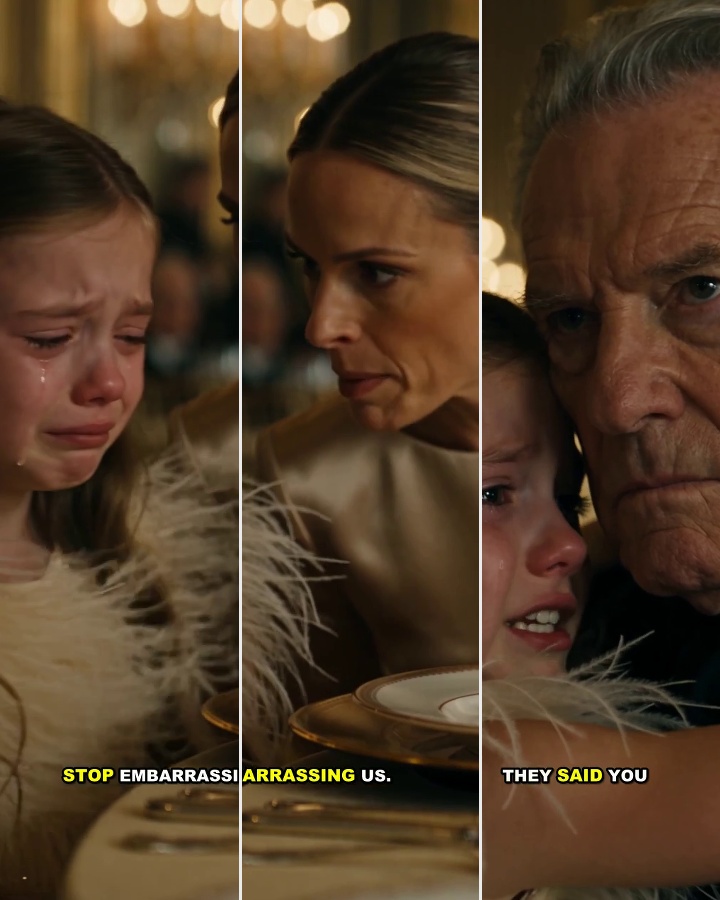
The little girl crying at a lavish dinner.
The aunt hissing:
“Stop embarrassing us.”
The ballroom doors opening.
An older man appearing.
Walking straight through the crowd.
Lifting the child into his arms.
Then asking:
“They told you I wouldn’t come, didn’t they?”
It sounded like a story about one cruel lie.
It was bigger than that.
Years of adult conflict had been compressed into a child-friendly explanation.
Grandpa doesn’t come anymore.
Then:
Grandpa made his choice.
Then:
Grandpa won’t come.
Each sentence removed more context.
Eventually Elsie inherited a conclusion nobody had properly proved:
Grandpa does not want me.
That was the deepest harm.
Gideon had done things wrong.
He had blamed Everett unfairly.
He had allowed anger to turn into distance.
Everett had done things wrong.
He had avoided hard conversations and let silence become an answer.
Celia had done things wrong.
She had intercepted communication and manipulated information because she believed control would create peace.
Nobody needed to become innocent for the truth to become clearer.
And Elsie never again accepted one sentence about a family conflict without asking another question.
Years later, during a history assignment, her teacher wrote on the board:
WHO CONTROLS THE STORY?
Elsie smiled immediately.
She already knew why the question mattered.
At her eighteenth birthday dinner, Gideon arrived ten minutes late.
Elsie stood when he entered.
He looked embarrassed.
“Traffic.”
She folded her arms.
“They told me you wouldn’t come.”
Gideon stared at her.
Then realized she was joking.
He laughed so loudly half the restaurant turned.
Elsie hugged him.
This time nobody had kept them apart.
No intercepted letters.
No adults deciding the child was better off with a simpler lie.
Just a grandfather who showed up.
And a granddaughter old enough to know that love could survive conflict only when people stopped controlling the truth about it.
THE END
“`