Chapter 10 — What Everyone in the Ballroom Remembered
The next Riverton Children’s Arts Gala looked different.
Not dramatically.
Still chandeliers.
Still flowers.
Still music.
But several policies had changed.
Children performing at the event had designated waiting areas.
Staff supervision assignments were written clearly.
No employee was expected to hide mistakes from donors.
And any incident involving a child required a parent or guardian before confrontation.
Richard added one line to the staff handbook:
OBSERVATION IS NOT THE SAME AS CONCLUSION.
Elise eventually returned in a different role.
She apologized directly to Claire and Emma.
She did not pretend fear excused what she did.
“I knew there was more to the story,” she told Claire.
“And I gave Victoria only the part that protected me.”
Claire nodded.
“That’s what hurt Emma.”
“I know.”
Oliver and Emma saw each other several months later at a children’s concert.
He approached awkwardly.
“I’m sorry about the table.”
Emma shrugged.
“Don’t crawl under fancy tables anymore.”
Oliver nodded.
“Good rule.”
Then he added:
“Thanks for pushing me away.”
Emma smiled.
“You would’ve gotten flowers on your head.”
“Better than Grandma’s bucket.”
Claire overheard.
She almost laughed.
Then decided she probably shouldn’t.
Victoria was no longer honorary chairwoman.
But she remained a donor.
Quietly.
No speeches.
No special seating.
No controlling every detail of the memorial display.
The following year, Caroline’s memorial was much simpler.
A photograph.
A vase of white roses.
And a table where children could leave drawings.
Victoria approved it without changing a single ribbon.
Richard nearly fainted.
“Are you feeling well?” he asked.
Victoria looked at him.
“Don’t ruin the moment.”
But she smiled.
The person who changed most, however, was Claire.
She had never doubted that adults should protect children.
But after the gala, she understood something more specific.
Protection sometimes meant slowing a room down.
Stopping adults from turning suspicion into punishment before facts existed.
Months later, Emma accidentally knocked a glass of juice from a table at home.
It shattered.
Emma immediately froze.
Then said:
“That was me.”
Claire looked at her.
“Okay.”
Emma looked surprised.
“You’re not mad?”
“I’m not happy about broken glass.”
Then Claire smiled.
“But accidents and lies aren’t the same thing.”
They cleaned it together.
Emma had learned something too.
Telling the truth did not guarantee adults would always react perfectly.
But it mattered.
And when someone refused to listen…
it was okay to ask for another adult.
It was okay to ask for evidence.
It was okay to say:
“That’s not what happened.”
The ballroom incident remained difficult for Claire to remember.
Videos had circulated among guests that night.
Claire asked friends not to repost them.
Most respected that.
She never wanted Emma’s humiliation turned into entertainment.
But Claire kept one piece of security footage.
Not the bucket.
Not Emma crying.
The earlier recording.
Oliver crawling beneath the table.
The cloth moving.
The display beginning to fall.
Then Emma running toward it.
Small hands pushing Oliver away.
One arm reaching toward the glass column.
Blue dye spilling.
Flowers falling.
And Emma staying there even after Oliver ran.
That was the part Claire wanted remembered.
Years later, Emma asked:
“Why did you save that?”
Claire answered:
“Because everybody saw you crying afterward.”
Then:
“I wanted us to remember what happened before.”
That was where the truth lived.
Before Victoria walked over.
Before Elise gave an incomplete explanation.
Before guests gathered.
Before the silver bucket was lifted.
A child saw another child in danger.
And tried to help.
That was what actually happened.
The night itself had begun to go wrong only minutes before Claire arrived.
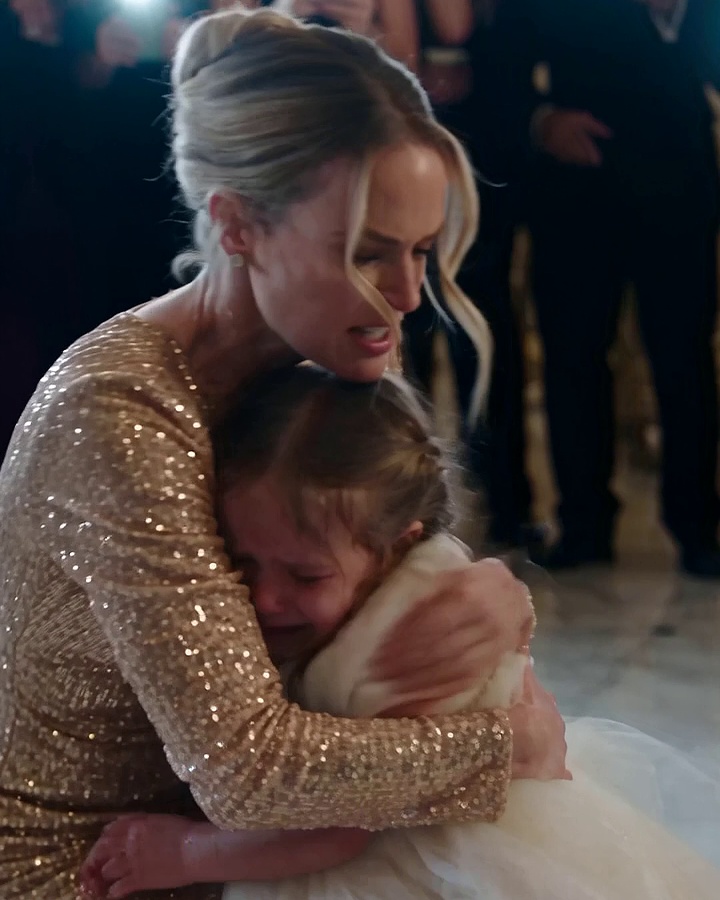
Emma sat crying on the marble floor.
Victoria walked toward her.
Silver bucket in hand.
People watched.
No one expected what came next.
Water poured over Emma.
Gasps filled the ballroom.
Phones rose.
Emma sobbed.
Then Claire pushed through the crowd.
“Emma!”
She wrapped her daughter in her arms.
Then looked up at Victoria.
“You did this to my daughter?”
Victoria refused to back down.
She believed Emma had damaged Caroline’s memorial.
She believed humiliation was a consequence.
She believed certainty was enough.
Claire stood.
Kept Emma behind her.
Then said:
“You humiliated a child in front of everyone.”
Victoria stared back.
Claire stepped closer.
“And you’re going to regret choosing her.”
Not because Claire planned revenge.
Not because she wanted violence returned for humiliation.
Because there were witnesses.
There were cameras.
There were facts.
And Victoria had acted before checking any of them.
The footage eventually exposed everything.
Oliver pulled the tablecloth.
Emma tried to save him.
Elise withheld the truth because she feared Victoria.
Victoria reacted exactly as everyone feared she would.
And one moment of public cruelty forced the entire organization to confront a much bigger problem.
People had become so afraid of Victoria’s anger that telling her the truth felt dangerous.
Victoria spent years believing her strictness kept standards high.
That night showed her the other side.
Fear did not always produce honesty.
Sometimes it produced silence.
Sometimes half-truths.
Sometimes scapegoats.
And sometimes…
a crying child standing beneath a silver bucket for something she never did.
At the following year’s gala, Victoria saw Emma across the ballroom.
She did not approach immediately.
She looked toward Claire first.
Claire nodded once.
Only then did Victoria walk over.
“Hello, Emma.”
Emma looked at her.
“Hi.”
Victoria pointed toward the simple flower display.
“No buckets this year.”
Emma stared at her for a second.
Then smiled slightly.
“Good.”
Victoria smiled too.
It was not forgiveness wrapped neatly in one conversation.
It was something smaller.
Safer.
Earned slowly.
And that was enough.
Because the most important lesson from that ballroom was never that cameras can expose a lie.
It was that no adult should need a camera to remember one basic rule:
Before punishing a child, make sure you actually know what happened.
THE END
“`