Chapter 13 — The Receipt Eliza Kept
Nolan and Celeste remained separated for almost a year.
They attended counseling.
Celeste worked specifically on guilt, favoritism and blended-family boundaries.
Nolan worked on his habit of avoiding conflict until resentment became impossible to ignore.
Eventually they decided not to continue the marriage.
Not because of one muffin.
Not because one birthday automatically defined their entire relationship.
The birthday exposed a deeper disagreement about parenting, fairness and the authority each adult believed they had over the other child.
Celeste remained Maisie’s mother.
Nolan remained emotionally important to Maisie even after the marriage ended.
The adults handled that carefully.
Eliza was never told she had “won.”
Maisie was never told her mother was the villain.
The girls themselves stayed close.
That surprised everyone except them.
As teenagers, they laughed about how much the adults assumed they secretly hated each other.
They had competed.
Fought.
Been jealous.
But neither had wanted what happened that birthday.
Seven years later, Eliza found the old crumpled receipt inside a memory box.
She was sixteen.
Maisie was eighteen.
They sat together on the bedroom floor.
Maisie read it.
“Seventy-four dollars for that cake?”
Eliza laughed.
“Was it good?”
“Honestly?”
“Dry.”
Eliza pointed toward the final line.
Blueberry muffin — $1.49.
Maisie looked toward her.
“Do you hate blueberry muffins now?”
“No.”
“I hate people making symbolic points with food.”
Maisie laughed.
Then became serious.
“I’m sorry.”
Eliza frowned.
“For what?”
“That the party was mine.”
Eliza shook her head.
“You were eleven.”
“You asked for two cakes.”
Maisie smiled weakly.
“I did.”
“You did.”
That mattered.
The receipt itself eventually became less painful.
At first, Nolan saw it as proof of cruelty.
Later he understood it more precisely.
It showed planning.
Celeste had purchased everything together.
She knew that day was Eliza’s birthday.
She planned a full celebration for Maisie.
Then deliberately selected something minimal for Eliza.
Not because the family lacked money.
Not because the bakery made a mistake.
Not because she forgot.
The disparity had been intentional.
But the price was never what gave Eliza value.
A $1.49 muffin could have been a wonderful birthday breakfast if somebody had placed it in front of her with love.
A seventy-four-dollar cake could still feel empty if it were being used to prove who mattered more.
The object did not determine the message.
The intention around it did.
Meredith kept the original phone recording for as long as it was useful.
She never posted it.
Never showed it at holidays.
Never used Eliza’s tears as family entertainment.
Years later, Eliza asked whether it still existed.
Meredith nodded.
“Do you want it?”
Eliza thought.
“No.”
“You sure?”
“I remember enough.”
So Meredith deleted her personal copy once there was no longer a reason to preserve it.
Eliza kept the receipt.
Not because she wanted to stay angry.
Because it reminded her of something she learned much later.
As a child, she had looked at the numbers and thought:
Maisie was worth $74.
I was worth $1.49.
That belief had taken years to remove.
Nolan once asked her:
“What would you tell nine-year-old you now?”
Eliza answered immediately.
“That receipts show what people bought.”
“Not what people are worth.”
On her eighteenth birthday, Nolan asked what cake she wanted.
Eliza smiled.
“No cake.”
He stared.
“Seriously?”
“Blueberry muffin.”
Nolan groaned.
“You’re doing this on purpose.”
“Absolutely.”
Maisie arrived carrying an entire box of supermarket muffins.
She had taped a handwritten sign to the top:
$1.49 EACH.
PRICELESS FAMILY DRAMA INCLUDED FREE.
Eliza laughed until she cried.
This time the tears were different.
They put candles into three muffins.
Sang too loudly.
Ate them standing in the kitchen.
No ballroom.
No professional cake.
No one sitting alone in the next room.
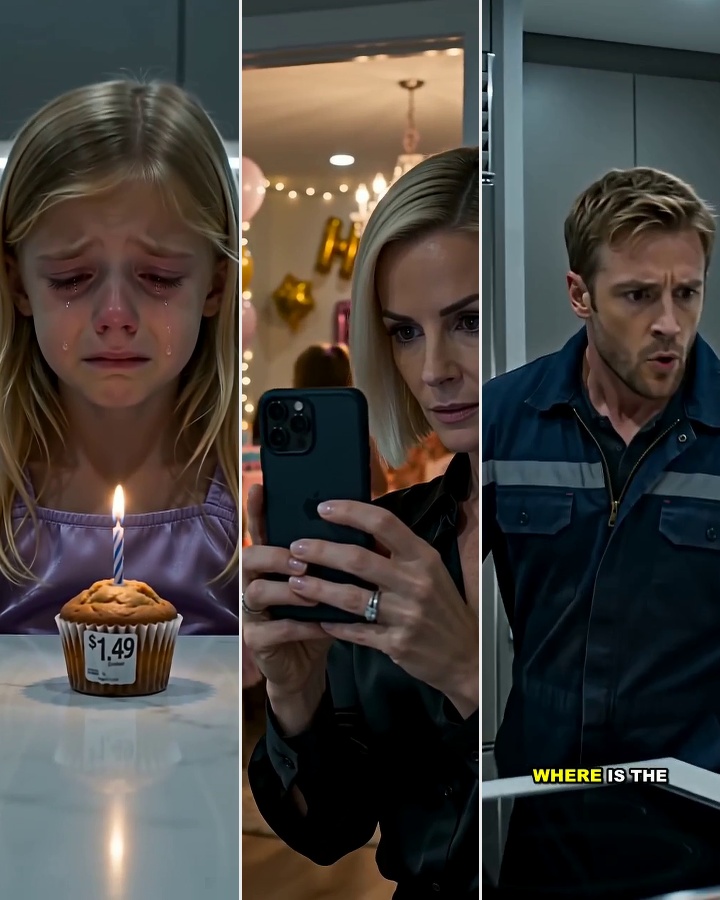
Years earlier, Nolan had walked into that same kitchen and found his daughter staring at one tiny candle.
He saw the $1.49 sticker.
Then she handed him a crumpled receipt.
The receipt showed the expensive cake.
The decorations.
The favors.
The party prepared for someone else on Eliza’s birthday.
At first, Nolan thought the receipt exposed how little money had been spent on his daughter.
Eventually he understood the deeper truth.
It exposed how deliberately she had been made to feel like she mattered less.
That was the part the family had to repair.
And no amount printed at the bottom of a receipt could ever measure whether they succeeded.
THE END
“`