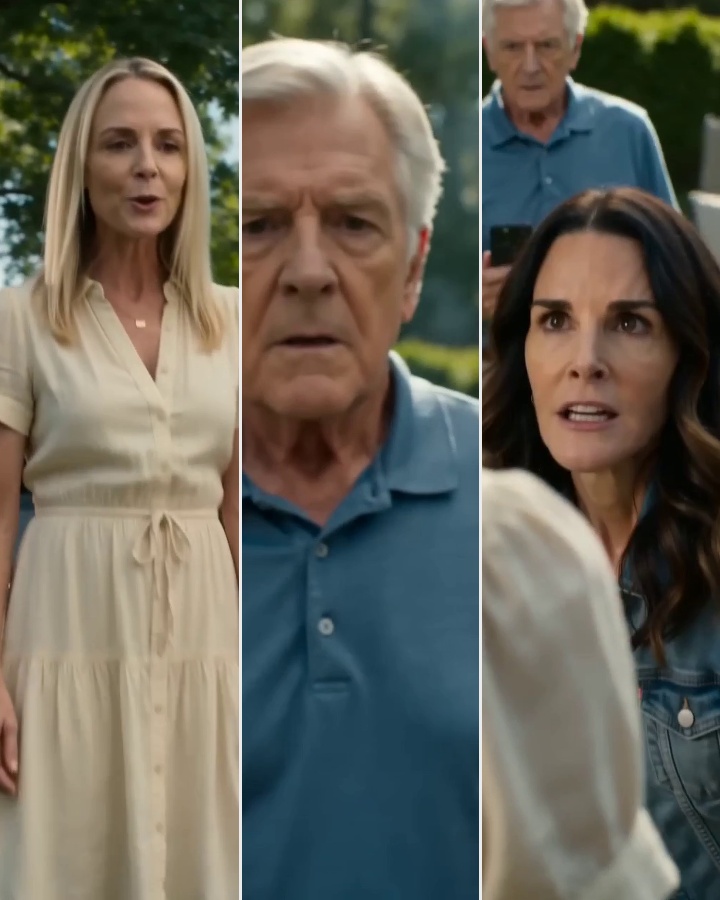
Chapter 13 — The Barbecue Grandpa Filmed by Accident
Eight years later, Brielle was seventeen.
The scar on her leg was faint.
She rarely thought about it.
The old video still existed.
Preserved with legal records.
Orson never watched it for nostalgia.
He hated that people sometimes described him as the hero who “caught everything on camera.”
“I was filming children spraying each other with a hose,” he once said.
“I got lucky.”
Brielle corrected him.
“We got lucky.”
Because without the footage, Cecily’s original explanation might have sounded plausible.
A child moving near a barbecue.
A sharp tool nearby.
An accident.
That was possible.
The video forced the adults to examine what happened before the injury.
It showed the confrontation.
The object in Cecily’s hand.
Brielle backing away.
And the immediate aftermath.
But years later, Brielle understood something important.
The camera had not actually captured the entire truth.
It did not record every earlier incident.
It did not show Cecily’s resentment growing.
It did not show relatives dismissing harshness as personality.
It did not record all the times Brielle felt uncomfortable but lacked language strong enough to make adults act.
The video captured one afternoon.
The pattern had started earlier.
Cecily eventually rebuilt limited relationships with some relatives.
Not everyone.
Her relationship with Maren never returned to what it had been.
They could speak politely years later.
That was all.
Brielle chose, when older, to exchange occasional messages with Cecily.
That was her decision.
Maren did not demand forgiveness.
She also did not demand permanent hatred.
Maisie grew up understanding the barbecue differently than she had as a child.
At fifteen, she once asked Brielle:
“Were you mad at me because of the cookie?”
Brielle stared at her.
“Why would I be?”
Maisie shrugged.
“Because it started over me.”
Brielle shook her head.
“No.”
“It started because an adult couldn’t handle being disobeyed without turning it into something dangerous.”
Maisie began crying.
Brielle hugged her.
Neither child had caused it.
That was another lie they had spent years unlearning.
Eventually the family held barbecues again.
Not at first.
For two summers, they chose other gatherings.
Then one year Brielle said:
“Can we stop letting one awful afternoon own grilled corn forever?”
Orson laughed.
So they tried.
The grill stayed in an adult-only cooking area.
Sharp tools stayed on the preparation table.
Children were given clear safety rules.
And nobody used those rules as an excuse for humiliation or intimidation.
At the first new barbecue, Orson raised his phone.
Brielle pointed at him.
“Grandpa.”
He froze.
“What?”
“Food only.”
“No accidental crime documentary.”
Everyone laughed.
Even Orson.
He photographed the burgers.
Years earlier, that ordinary family afternoon had turned into something none of them expected.
Brielle collapsed onto the grass screaming.
A sharp metal skewer lay nearby.
Cecily immediately said:
“She ran into it.”
Then Grandpa lifted his phone.
The recording showed a different sequence.
Later, Maren confronted her sister:
“You thought nobody would find out?”
For a long time, that line became the family’s favorite retelling.
But Maren eventually stopped using it.
Because she realized something.
The goal was not to teach Cecily that she should behave better when cameras were present.
The goal was to teach the entire family that child safety should never depend on somebody happening to record the right moment.
Adults should have noticed sooner.
They should have taken smaller incidents seriously.
They should have challenged the phrase:
“It’s just discipline.”
They should have asked why Brielle became tense around Cecily.
The phone gave them evidence.
But evidence only mattered because, finally, the adults chose not to look away from what it showed.
THE END
“`